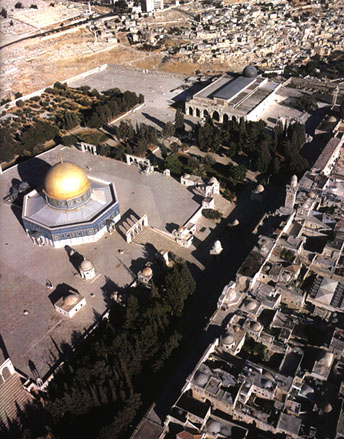
THE TREASURES OF THE HOUSE OF THE LORD
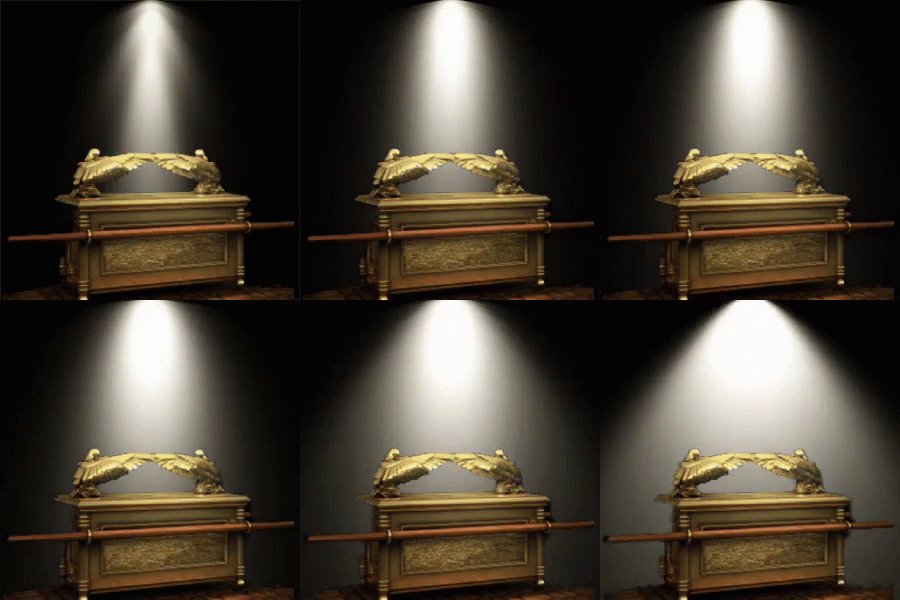
What happened to the Ark of the Covenant?
Chuck Missler versus Michael Heiser

- Bill Perkins - www.compass.org
".... 'Have you (Gog/Russia) come to capture spoil? Have you assembled your company to seize plunder, to carry away silver and gold, to take away cattle and goods, to capture great spoil?'" Ezek. 38:13
How much gold and silver would it take for Russia to be enticed to invade Israel to steal it all? A bunch. It would have to be a tantalizing amount, probably in the mega billions, if not trillions, of dollars. But even if Israel were to discover a mega hoard of gold and silver, enough to entice the Russians, the timing of such an invasion (basically starting World War III), would have to be seen as the "perfect window of opportunity." Well, the Bible says Russia WILL invade Israel to steal her gold and silver and this future invasion is described in Ezekiel 38 and 39... a fascinating read. And a great "opportunity window" will open for the Russians to make their move during the 50 chaotic days between Rapture and the signing of the 10-Nation Peace Treaty. (1) Think about it--the United States is Israel's only true ally, and the U.S. will be decimated from the effects of losing key people in the sudden Rapture. So Israel will be alone in the world to fend for herself. At least that's what the Russians will think. They will conclude they can invade and capture the vast treasure for themselves. But God comes to Israel's help in a mighty way to supernaturally protect Israel. And Russia goes down in an embarrassing defeat. (2)
Are the riches future oil discoveries? Nope So, if we're as close as I think we are to the Rapture, where is this great treasure that Russia will be trying to capture? For years I must admit I thought the treasure would be Israel striking huge amounts of oil. And indeed they have struck a great quantity of oil and gas. But thinking about that reasoning, Saudi Arabia has a lot more oil with far fewer national defenses and I don't see Russia going after Saudi's oil.
Massive amounts of gold and silver? Yes! And now, as I've reread the text of Ezek. 38:13, I realize I was wrong. It's not oil. The Bible specifically says Russia comes after "silver and gold." I'm quite humbled that I missed that. However, there's a problem. At the moment Israel doesn't have vast amounts of gold and silver. They do have a great diamond-cutting business, world renown. But they just cut other people's diamonds. So how in the world could Israel end up with enough gold and silver to entice Russia to invade? Well, as it turns out, the Bible says that amount of gold and silver treasure is already in Israel, they just need to find it-quite interesting, huh!
Hang with me as I back up a bit... Solomon was the richest man in the world, literally. His treasures were unfathomable. God gave him his wealth because he wisely asked for wisdom, not riches, but God rewarded him for his humble answer and gave him both wisdom AND wealth...great wealth (1Kings 3:9-13). The Bible, and even 1st century Jewish historian Josephus, mentions that Solomon had a fleet of ships that did business all over the Mediterranean. And each time the fleet returned to Israel they brought the trip's profit in gold to King Solomon.
Just how rich WAS Solomon? Solomon had dominion over everything from west of the Jordan River to the Egyptian border in the south and north into present-day Syria. And God allowed him to be at peace with the surrounding nations (1 Kings 4:24). He was in the perfect place to make tons of money. In 1Kings 9:26-28, it records that a fleet of his ships returned to Israel with a profit of 31,500 pounds of gold! That's over $750 million in today's value. And that was from just one sea-faring business trip abroad. In 1Kings 10 it says the Queen of Sheba came to Israel to pay Solomon a visit to hear his wisdom and see his wealth. She was stunned-so impressed that she was moved to give Solomon over $200 million in gold plus untold numbers of precious stones. The amount of gold and silver that Solomon acquired during his kingship was beyond imagination, as you will soon see.
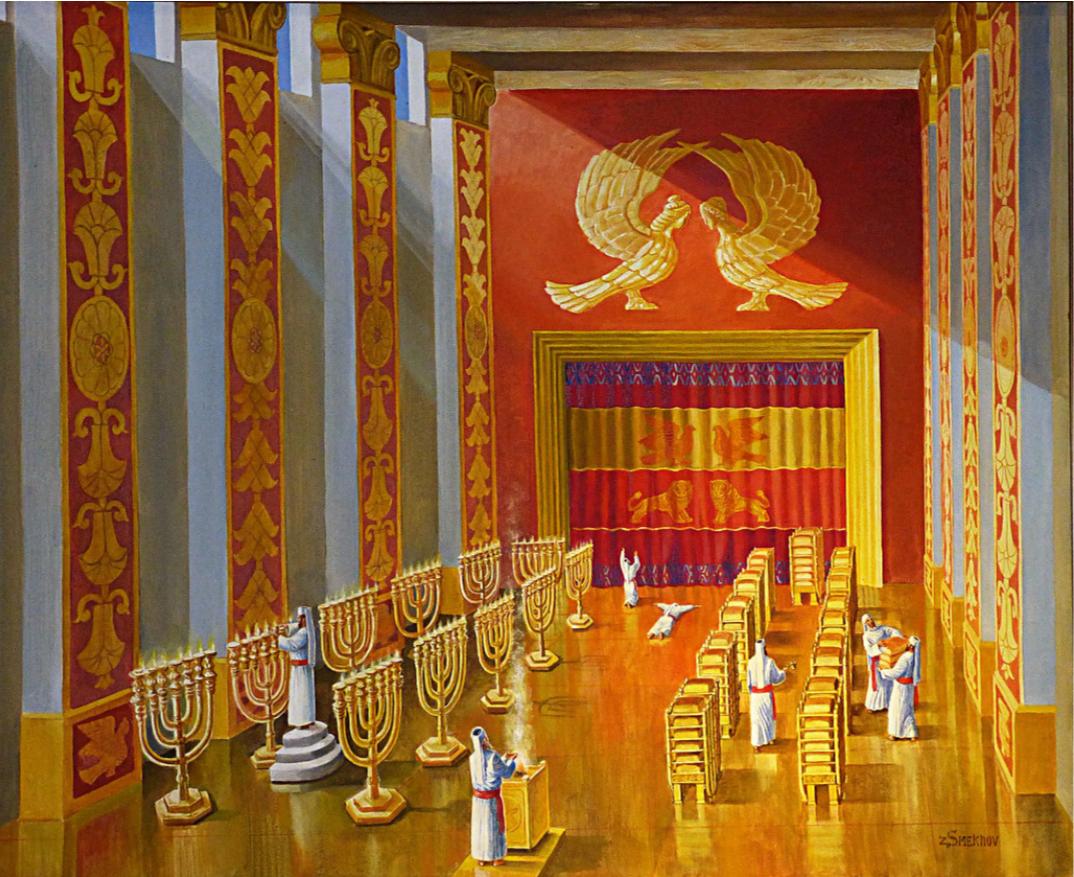
Solomon builds the 1st Jewish Temple In 970 BC, Solomon built the first Jewish Temple to be a permanent replacement for the Tabernacle that had been carted around the Middle East for hundreds of years. The building of the Temple makes a good outline for a business plan, in writing, dealing with planning, labor, and materials management (1Chron. 28; 1Kings 5,6). Solomon was so rich when he built the Temple that, rather than putting in just one solid gold menorah, he decided to multiply the contents on the inside of the Temple by 10. So Solomon made nine more solid gold menorahs and lined up the ten in two rows of five each (2Chron. 4:7,8). This means there were ten 6 foot high solid gold menorahs in the 1st Jewish Temple. (See drawing of the inside of the 1st Temple made by the Temple Institute in Jerusalem). Each of those solid gold menorahs was so heavy that the Temple priests estimated their value at $360 billion each, $2.5 trillion value for all 10! Solomon also increased from one solid gold Table of Showbread to 10. Each of these solid gold tables held twelve loaves of bread. The Temple Institute says they would have been about five feet high, four feet wide and four feet long. That's a lot of gold. And a lot of bread to bake daily. We don't know how much the Tables of Showbread weighed-they only had to each hold 12 loaves of bread-but they still were solid gold. See pic of man carrying the bread. However, if they weighed 1/4 of the menorahs, that's another $500 billion in value for the 10 tables. And this doesn't include all the golden bowls, plates and such that numbered in the thousands. Again, Solomon could afford to make all this because he had unfathomable riches. His wealth of gold, silver, precious stones and other things became legendary. So much so that ultimately Israel became a target for conquering by surrounding nations. With all that success, Israel got her eyes off the Lord. Even Solomon brought in hundreds of foreign wives and concubines to pleasure himself. And 40 years later, 930 BC, Israel split into North and South. The North, Israel, set up its own sacrifice system. But sacrifices could only be made on Mt. Moriah, and breaking that rule didn't last long. Three years later, the Assyrians conquered Israel's Northern 10 tribes in 927 BC. But Assyria was unable to capture the real prize-Jerusalem/Judah in the South with all her riches. The South, Judah, held on for over a hundred years, but finally Jerusalem was conquered by Nebuchadnezzar's armies in 586 BC. History tells us that Nebuchadnezzar, King of Babylon, plundered the Temple and deported Jerusalem's wealthy and educated inhabitants to Babylon. They looted what they found in the Temple. But apparently Israel had thrown a bone, leaving what seemed like a great treasure to find and seize, but it was actually only a fraction of the whole treasure, only about 2% of the total massive treasure. The 5400 items that were captured were eventually returned by Cyrus, King of Persia, when he authorized their rebuilding of the Temple after Israel's 70 years of Babylonian Captivity. The Bible is clear that Cyrus returned all that had been stolen, even listing out the items. But none of the 10 solid gold menorahs were mentioned, or any tables of showbread on Cyrus' list (Ezra 1:9-11). Nor was there any mention of the other tens of thousands of gold and silver Temple implements, or gold and silver bars from the treasury. Now, since only a small fraction of all that gold and silver went to Babylon, what happened to the other 98%? Basically we're missing the entire fortune that Israel had accumulated under Solomon.
Where did the Temple treasures go? In the Jewish Talmud, tradition says that King Josiah and the Temple priests hid the vast treasure, including the Ark of the Covenant, in secret winding passages under the Temple Mount 10 years before the 1st Temple's destruction. Well, the Jews are a smart people, and Israel did have 140+ years to think about what to do if Jerusalem was ever conquered like their brothers in the north. And Zechariah, God's prophet of the day, was continually hammering the Israelites to wake up and clean up their sins or the Lord would allow them to be conquered like their Northern brothers. Zechariah, unlike most other prophets, was also a Priest. He knew it was possible that Israel was going to be conquered. And he would have had first-hand knowledge of the vast riches stored in the Temple treasuries. He was in the unique position to approve plans to hide the treasure if it looked imminent that Israel would be conquered, his own predictions. Zech would certainly want to protect as much of Israel's riches he could, including those 10 golden menorahs and 10 golden Tables of Showbread. Not to mention the hugely important Holy Ark of the Covenant that contained Moses'/Aaron's staff and the two stone tablets with the 10 commandments. So apparently Zech approved the hiding/burying of the Temple treasures. And Israel was smart enough to throw the Babylonians a bone. They left in the Temple several thousand gold and silver utensils, which would normally be significant spoils of war. The ruse worked. History tells us that Nebuchadnezzar plundered what they found in the Temple and deported Jerusalem's upper-class citizens, like Daniel, to Babylon. However, Zech hid the rest of the treasure so well it's never been found to this day.
Qumran and the Copper Scroll
Since 1947, in and around Qumran down by the Dead Sea, thousands of pieces of parchment were found buried in caves in the cliffs surrounding the area. Collectively called the Dead Sea Scrolls, their discovery came within months of Israel becoming a fledgling nation again, and Jews today readily admit the discovery helped awaken Jews around the world to their Biblical roots. But in 1952 another scroll was found, one made not of parchment but of copper mixed with a tiny bit of tin. This copper scroll wasn't found near any of the parchment scrolls, but rather by itself, on a carved out shelf in the back of a cave in the area of Qumran. Since it was written on copper, whoever wrote it thought the contents so valuable they had to make permanent indentations in metal to stand the test of time. All the other Dead Sea Scrolls contained Old Testament books, scripture commentaries, and general Jewish life observations. But the Copper Scroll was simply a list of instructions of where tons of gold, silver and precious stones were buried. But, as Frank Peretti said in his classic THE CHAIR presentation, you have to have a "fixed point of reference" to know where to begin any journey. And there are no reference points in the Copper Scroll instructions. Though many have tried, no one yet has been able to figure out the right place to dig. Probably they were written vaguely on purpose because once they find just one of the 64 locations, they can find the rest of the massive treasure. Biblical archaeologists who've analyzed the Copper Scroll believe it to be written by five different people who apparently were in a hurry to complete the scroll. Hebrew priests normally take great care in making each line perfect, but the Copper Scroll looks as if time was of the essence to complete it. Lines are not uniform, some letters are hard to read, there are misspellings, etc. The Copper Scroll is most fascinating because 63 of the 64 locations described listed staggering quantities of gold and silver. There are even some large unnamed items that very well could be the 10 missing 1st Temple menorahs and Tables of Showbread. In total, there was over 345,000 pounds of gold and silver listed, not counting the 10 menorahs and 10 Tables of Showbread. That's over $5 trillion! Certainly enough to entice the Russians to "devise an evil plan." (Ezek. 38:10) But, as the commercials always say, "That's not all!"
More to the story...2 Maccabees 2:1 (granted it's not part of inspired Hebrew scripture, but heavily relied on and quoted by Jewish historians) mentions that Jeremiah, another of God's prophets at the same time of Zechariah, made records of the Temple inventory. He even warned those helping him make the records not to be "led astray in their thoughts upon seeing all the gold and silver." The Maccabean text continues to say that Jeremiah then found a cave to store the treasure, including the Ark of the Covenant, and covered up the entrance saying the treasure would not be found until "God gathers His people together and shows His mercy." Over the last 75 years, several Americans have raised and spent small fortunes looking for the Temple treasures in Israel. Most notably, John Allegro, Vendyl Jones, Oren Gutfield and Jim Barfield. Others, like Randall Price, go on yearly digs to find anything they can. So the area will eventually yield its fruit.
In the meantime, with each failure of discovery the chorus of naysayers who don't believe the treasure is real grows louder and louder. But all that gold and silver is hiding somewhere and will one day be found.
A Most Intriguing List Several hundred years ago, some Hebrew scholars decided to try to locate these "other records" that Jeremiah mentioned. They found what they were looking for in the Emeq HaMelekh, which means "Valley of the Kings." In 1648, a Rabbi translated Emeq HaMelekh and his translations were discovered in 1992. Emeq HaMelekh is a Hebrew account of five Temple guardians who hid the Ark, the Sanctuary and the Treasures of Solomon's Temple. Could those five be the same five guys on the Copper Scroll? Very plausible, to say the least. Most importantly to this article, the Emeq HaMelekh has a lot in common with the Copper Scroll list of Temple treasures, but it lists about 100 times more pieces of gold and silver. Now we're easily into the mega trillions of dollars worth of gold and silver to be found. To save space I have made an edited (but numerically accurate) recap of the Emeq HaMelekh. I have added calculated amounts in parentheses in today's dollars on some of the items to give you a feel for what it is saying. [Note: A talent was approximately 75 lbs.]
Emeq HaMelekh These are the vessels dedicated and concealed when the Temple was destroyed:
Mishnah 1 The Tabernacle and the Curtain, The Holy Menorah, The Ark of the Testimony, The golden forehead Nameplate, The golden crown of Aharon the Cohen, The Breastplate of Judgement, The liver Trumpets, The Cherubim, The Altar of burnt offerings, The curtain of the Communion Tent, The forks and the bread molds, The Table of Showbread. (The list continues with several pages of priestly garments)
Mishnah 2 These are the holy vessels and the vessels of the Temple that were in Jerusalem and in every place. They were inscribed by shimmer Halevi and his companions on a Lunch Nehoshef Copper Plate with all the Vessels of the Holy of Holies that Shalom son of David made. And together with Shimus were Hizkiyahu, Zidkiyah, Haggai the Prophet, and Xechariah, son of Berachiah, son of Iddo the Prophet.
Mishnah 3 These are the vessels of the Temple that were taken and buried in the ground: The locking rods, The pegs, The boards, The rings, The standing pillars of the courtyard These are the Vessels: 1,200,000 silver Mizrakot (sacrificial basins), 50,000 fine gold Mizrakot (sacrificial basins), 600,000 bowls of fine gold, 1,200,000 bowls of silver.
Mishnah 4 500,000 trays of fine gold 1,200,000 trays of silver 500,000 bread mold of fine gold 1,200,000 bread molds of silver On each of the molds there were 5 Margaliot/pearls and 2 precious gem stones. The value of each precious stone was 100 talents of gold ($180 million). The total value of all the Margaliot was 200,000 talents of gold ($360 billion). 36 golden trumpets 7 branched menorah of fine gold worth 100,000 talents ($360 billion)
Mishnah 5 77 tables of gold 7,000 talents of gold (Over $10 trillion) 3 rows of priceless stones, 7 cubits by 5 cubits
Mishnah 7 The counting of precious stones, Margallot gems, silver, and gold that King David dedicated to the great Temple was: 1,000,000 talents of silver ($18 billion), 100,000 talents of gold ($180 million) 600,000 talents of fine gold ($1.08 trillion) All these were concealed, hidden and safeguarded from the army of the Chaldeans in a place called Borseef.
Mishnah 8 7 golden curtains with 12,000 talents of gold ($20 billion) 12,000 Levitical garments with belts 70,000 Levitical garments with belts, turbans and pants All of these service clothes were concealed until the future to atone for Israel in the end of days.
Mishnah 9 David also made: 1,000 copper lyres overlaid with fine gold and 8 stones 7,000 harps All these were hidden and concealed in Ein Zidkiyah that the fittest men of Israel knew in secret, lest they fall, G-d forbid, into the hands of the enemy who hated Israel. These vessels are not to be used except to atone for Israel, thus concealed to prevent the Chaldeans from using them, G-d forbid. They hid them until the day when Israel will return to their former stature and reclaim eternal honor and worldly glory, and they find a man named David, son of David. The silver and gold shall then be unearthed to him, when all Israel shall gather and make a complete Aliyah ascent to Jerusalem. Amen.
Mishnah 10 These are the weights of silver concealed at Ein Kahal by Baruch and Zidkiyah: 1,200,000 talents of silver, 1,600,000 of fine silver, 2,000,000 pots of fine copper, 1,100,000 pots of iron, 3,000 frying pans of fine gold, Countless copper sinks and lavers, 70 tables of fine gold. All those were concealed by Zidkiyah.
Mishnah 11 Treasures of gold and silver stored away from the days of David until Sidkiyah and until Israel was exiled to Babylon. Hundreds of thousands of golden shields, Countless silver shields, 353,000 precious stones, 1,900,000 Korin of gold [no clue what that weighs] All the prophets, wise men, and scribes in the world could not calculate the wealth and the glory that was in Jerusalem.
Mishnah 12 Twelve precious stones with the names of the Tribes engraved on them. No king, prophet, or anyone else knew where they were hidden, excepting Hiluk, son of Shimus Halevi. All Israel concealed the Vessels until a righteous king arises over Israel. What's more, they all share a solemn vow never to reveal the whereabouts of these vessels until David, son of David, arises. All silver, gold, and Margaliot precious stones which were ever hidden away will be handed over to him when the exiles of Israel will be gathered from the four ends of the earth, and they ascend with greatness and exaltation to the land of Israel. At that time a great river will issue forth from the Holy of Holies of the Temple. Its name is Gihon and it will flow to the great and dreadful desert and become mixed with the Euphrates River.
End of Emeq HaMelekh Well there you have it. Trillions of dollars of gold and silver are still hidden somewhere in Israel. Not to mention those 3,000 gold frying pans! :-) And when they do find that incredible treasure, look up! Luke 21:28 "But when these things begin to take place, straighten up and lift up your heads, because your redemption is drawing near."

Update for 2023: At a price of US$1,945 per troy ounce, one ton of gold has a value of approximately US$67 million. The best estimates currently available suggest that around 190,040 tonnes of gold has been mined throughout history, of which around two-thirds has been mined since 1950. And since gold is virtually indestructible, this means that almost all of this metal is still around in one form or another. If every single ounce of this gold were placed next to each other, the resulting cube of pure gold would only measure around 21 metres on each side.


1. Mazar, Benjamin, The Mountain of the Lord, Doubleday Publishing, New York (1975).
2. Yadin, Yigael, Jerusalem Revealed, Yale University Press, London (1976).
3. Kenyon, Kathleen M., Digging Up Jerusalem, London (1974).
3. Landay, Jerry M., Silent Cities, Sacred Stones, McCall Books, New York (1971).
4. Keil, C. F., and F. Delitzsch, Commentary on the Old Testament, Vol. III, Eerdmans Publishing Company, Grand Rapids, Michigan, reprinted October 1978.
6. Ironside, H. A., The Four Hundred Silent Years, Loizeaux Brothers, Neptune, New Jersey, (1914).
7. Herzog, Chaim and Gichon, Mordechai, Battles of the Bible, Random House, New York, (1978).
8. Gulston, Charles, Jerusalem, Zondervan Publishing, Grand Rapids, Michigan, (1978).
8. Edersheim, Alfred, The Temple, Eerdmans Publishing Company, Grand Rapids, Michigan, ( 1979).
9. Landay, Jerry M., Dome of the Rock, Newsweek Publishing, New York (1972).

Lambert Dolphin

Lambert Dolphin's Main Library
Email is welcome: Lambert Dolphin
Archive for Newsletters
Templemount.org Homepage
Library Annex (800+ new articles since 2018. Free, help thyself)
Audio Library (mp3)
My Search
Interviews