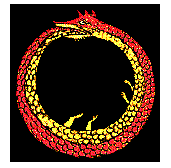
also called the ouroboros

also called the ouroboros
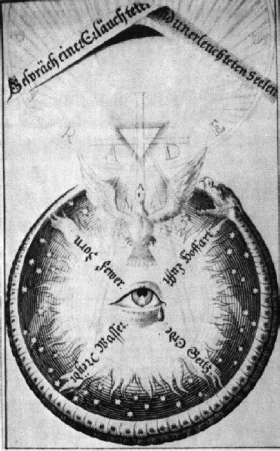
The above illustration is by the Christian mystic
Jacob
Boehme (1575-1642) published in his Theosophische Werke,
(Amsterdam 1682). It is referenced as Plate 9 by Jolande Jacobi
in her outstanding book, The Psychology of C.G. Jung,
(Yale University Press, London, New Haven, 1973).
Dr. Jacobi says the following about this drawing: "It shows
a sinful world of creation, surrounded by the Serpent of Eternity,
the Uroboros, and characterized by the four elements and the sins
corresponding to them; the whole circle relates to the centre,
the weeping eye of God, i.e., the point where salvation, symbolized
by the dove of the Holy Ghost, may be achieved by compassion and
love."
 From
a Christian point of view, the present world system is controlled
by, and under the temporary dominion of the fallen angel known
as Satan, symbolized in the Bible by a great serpent. Men and
women in their natural state are fallen and self-centered. The
self-impregnating snake, the uroboros (or ouroboros) is
a fitting symbol for this self-referenced framework for our race
apart from God. Fortunately, God's sovereign grace operates both
from outside and from within our fallen world. The Lord's compassionate
identification with human misery, sorrow, and sin is well represented
by the weeping eye at the center. The dove, is of course, a well
known Biblical symbol for the Holy Spirit. The drawing also includes
flames which symbolize God as "a consuming fire." Boehme's
drawing is Trinitarian with its triangle symbolizing God's sovereignty
over all of creation. The cross of course symbolizes Jesus the
Son of God, the "Lamb of God slain from the foundation of
the world" for our sins.
From
a Christian point of view, the present world system is controlled
by, and under the temporary dominion of the fallen angel known
as Satan, symbolized in the Bible by a great serpent. Men and
women in their natural state are fallen and self-centered. The
self-impregnating snake, the uroboros (or ouroboros) is
a fitting symbol for this self-referenced framework for our race
apart from God. Fortunately, God's sovereign grace operates both
from outside and from within our fallen world. The Lord's compassionate
identification with human misery, sorrow, and sin is well represented
by the weeping eye at the center. The dove, is of course, a well
known Biblical symbol for the Holy Spirit. The drawing also includes
flames which symbolize God as "a consuming fire." Boehme's
drawing is Trinitarian with its triangle symbolizing God's sovereignty
over all of creation. The cross of course symbolizes Jesus the
Son of God, the "Lamb of God slain from the foundation of
the world" for our sins.
For all who are willing, God offers each of us an inner transformation
of identity from self-centered to self-giving. At enormous cost
to Himself God has made a way of escape for all who discover that
they have been born into an evil, selfish, fallen world. By nature
we do not have the resources to change ourselves into something
better---this is the resource the grace of God provides freely.
Receiving Jesus as Lord and Master into one's heart and life breaks
our inborn bondage to sin. Likewise shattered is our slavery to
the world and to the serpent-god of this present age. This process
is concisely stated by the Apostle Paul in Ephesians, Chapter
2,
"And you God made alive, when you were dead through the trespasses and sins in which you once walked, following the course of this world, following the prince of the power of the air, the spirit that is now at work in the sons of disobedience. Among these we all once lived in the passions of our flesh, following the desires of body and mind, and so we were by nature children of wrath, like the rest of mankind. But God, who is rich in mercy, out of the great love with which he loved us, even when we were dead through our trespasses, made us alive together with Christ (by grace you have been saved), and raised us up with him, and made us sit with him in the heavenly places in Christ Jesus, that in the coming ages he might show the immeasurable riches of his grace in kindness toward us in Christ Jesus. For by grace you have been saved through faith; and this is not your own doing, it is the gift of God---not because of works, lest any man should boast."
The reality that God is both Just and Compassionate is reflected by Jeremiah's words written at the time of Jerusalem's destruction by the Babylonians in 586 BC:
The self-enshrouded world we live in is the place of ultimate division between good and evil, between heaven and hell. The majestic God who created the universe continues to be deeply involved in all the affairs of our world---and the worlds that lie beyond. Ray C. Stedman wrote, "The proper attitude of Christians must be one of awe that a Being of such majesty and glory could find a way to dwell eternally with such sin-controlled and sin-injured creatures as us. 'Since our God is a consuming fire,' we must cry with Isaiah, 'Who of us can dwell with the consuming fire? Who of us can dwell with everlasting burning?' (Isaiah 33:14). God's love is just such a fire, it destroys what it cannot purify, but purifies what it cannot destroy. In Jesus we have a relationship that cannot be destroyed (Romans 8:38-39). Our great king is leading us through trials and difficulties in order that we may at last cry with Job, 'He knows the way that I take; when he has tried me, I shall come forth as gold' (Job 23:10 KJV). See Commentary on Hebrews.
Alas! and did my Savior bleed And did my sovereign
die?
Would He devote that sacred Head For sinners such as I?
Was it for sins that I have done He suffered on the tree?
Amazing pity! grace unknown! And love beyond degree!
Well might the sin in darkness hide And shut His glories in.
When Christ the great Redeemer, died For man the creature's sin.
Thus might I hide my blushing face While His dear cross appears.
Dissolve my heart in thankfulness, And melt mine eyes to tears.
But drops of grief can ne'er repay The debt of love I owe;
Here, Lord, I give myself away---'Tis all that I can do.
(Alas! and Did My Savior Bleed? Hymn by Isaac Watts)
The Meaing of the Oroborus (BBC)
Oroboros: Wikipedia
Oroborus--Ancient Symbol: Brittanica
Crystal Links

Solomon's Double Triangle


Originated: July 26, 1996. June 25, 2021

Original Library
Library Annex (since 2018)
Email is Welcome
Lambert Dolphin's Place
Newsletters Old and New