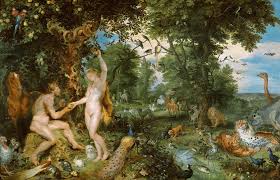

A popular book written by Larry Crabb in 1998 discussed the encounter our first parents Adam and Eve had with a fallen angel in the Garden in Eden. The main supposition of Dr. Crabb is that Adam sinned by standing passively by in the very presence of Eve while she yielded to the serpent's beguiling and ate the forbidden fruit. Therefore, men he concludes, are often passive and do not stand up in a protective role over their wives and families. Since sins of omission are often more serious than sins of commission, this is a big deal, said Crabb.
In our fallen world few can deny that men are often passive wimps and fail their wives and families and society by not acting when it was in their power to act and save the situation.
When I first read The Silence of Adam I immediately recalled the second book in C.S. Lewis' sci-fi trilogy, Perelandra --which contains a lengthy dialogue between a tempter attempting to lead the queen of a distant, unfallen planet into turning from the one true God and also from the king.
There is great mystery in how a totally innocent being can be tricked by any means into turning from the Creator to act in independence and to be one's own god. It certainly did happen at the beginning of our history, and that is our problem.
Genesis Chapter Three is shorter than we might like and as James Boice (3), Ray Stedman, and others have pointed out, if this one chapter were deleted from the Scripture we would never understand the rest of the Bible. Ray says (4),
"Remove this chapter from the Bible and the rest of it is absolutely incredible. Ignore the teaching of this chapter in history and the story of humanity becomes impossible either to understand or to explain. The most striking thing about this chapter is that we find ourselves here. You can't read through this story without feeling that you have lived it yourself, because, of course, you have. This account of the temptation and the fall is reproduced in our lives many times a day. We have all heard the voice of the Tempter. We have all felt the drawing of sin. We know the pangs of guilt that follow. This is why many call this story a myth. In the sense that it is timeless truth, perhaps, that word has certain rationality. But there are other implications of the term myth, which make it unsuitable to apply to this account. It is timeless in the sense that this is always happening to mankind, but it is timeless only because it is also fact. It actually did occur. It happens continually because it did once happen to our original parents, and thus, we, their children, cannot escape repeating it. In that sense there is no chapter in the Bible that is more up to date and more pertinent to our own situation than this third chapter of Genesis."
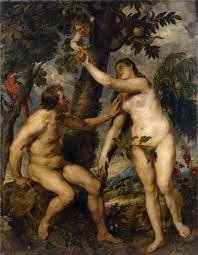
Below is the entirety of Genesis 3 so we can look at parts of it in detail verse by verse and think it through carefully step by step. I have inserted a few selected comments to highlight my main point in response to Dr. Crabb--Adam did not sin by not intervening when Eve ate the fruit. I'll also quote liberally from Ray Stedman who has an outstanding Commentary on Genesis on his web site.
1 Now the serpent was more cunning than any beast of the field which the LORD God had made. And he said to the woman, 'Has God indeed said, "You shall not eat of every tree of the garden?"' 2 And the woman said to the serpent, 'We may eat the fruit of the trees of the garden; 3 'but of the fruit of the tree which is in the midst of the garden, God has said, "You shall not eat it, nor shall you touch it, lest you die." 4 Then the serpent said to the woman, 'You will not surely die. 5 'For God knows that in the day you eat of it your eyes will be opened, and you will be like God, knowing good and evil.'
6 So when the woman saw that the tree was good for food, that it was pleasant to the eyes, and a tree desirable to make one wise, she took of its fruit and ate
Ray Stedman says,
"Now at this point it is important to note that Eve had not yet sinned. Even though her desire is aroused and her mind has justified it, still it is possible for her to recover herself, though it would be very difficult. But, as James tells us, desire when it is conceived gives birth to sin. And at this point it is recorded that, when she saw that it was good for food, and that it was a delight to the eyes, and that it was desired to make one wise, "she took of its fruit and ate." She acted on a lie, and thus fell into the sin of becoming her own god, of making up her own rules in violation of her humanity
"But now notice something else: Adam had not yet fallen, only Eve. There was still hope for the race. Thus the scene now shifts to Adam because it is not in Eve that the race fell. It is in Adam that the responsibility ultimately lies. A battle has been lost, but the war has not yet been lost. But then we read that, after she took of the fruit and ate, "she also gave some to her husband, and he ate." The ease with which Adam fell is dreadfully hard on the male ego. Think of it. Here is this whole account of the struggle of the Tempter to reach through to Eve, and but one little line about Adam, "she gave to him, and he ate." Yet in those innocent but ominous words, "and he ate," there begins the darkness of fallen humanity. The fatal twist now appears as mankind is transformed by this psychedelic drug (the forbidden fruit), and all men become the victim of a reverse psychology, mastered by emotional urges, no longer rational beings." (Reference 4)
She also gave to her husband with her, and he ate
The Hebrew text indicates that Adam was present with Eve when she ate the forbidden fruit. He was not in a distant part of the garden unaware of what was transpiring. It is at this point that Crabb suggests that Adam was wrong in not intervening to stop Eve from sinning. But is this true' I believe not.
Adam was still an innocent man until he also chose to eat the forbidden fruit. By definition an innocent man does not sin by nature. But Adam ate the forbidden fruit readily, apparently. His sin was deliberate. Eve erred in giving into clever deception. Paul summarizes this difference in 2 Timothy 1:14, "Adam was not deceived, but the woman being deceived, fell into transgression."
The Fall of man is clearly charged to Adam's account, not to Eve's. Adam is the federal head of our race. He was taught by God and given charge and stewardship over creation. His wife was given to him to be his companion--whom he taught, and led, and loved, and cherished. She had been formed from the side of Adam (Genesis 2) and was very "bone of my bones an flesh of my flesh."
Had Adam intervened to protect his wife it would have been a violation of her free will. Adam did not own Eve--God is her owner. Adam, did dare not to "lord" it over his wife. Higher than Eve's relationship to Adam is her relationship with God. Furthermore, Adam was still innocent until he ate the forbidden fruit--that is, he did nothing wrong by allowing Eve to sin! Even today, after our fall into total depravity, a husband should not lord it over his wife and order her around. We can advise a person or a wife, but can not force that individual by making their choices for them. (We do not know if Adam said anything to Eve as she was about to eat).
Note: Parents can overrule the choices of their dependent children of course--until the children become responsible and are on their own.
Crabb implies that Adam had this weakness of being passive even before he fell, which can not be true because Adam is "the son of God," (Luke 3:38)--until he, Adam, himself fell. Crabb does not draw a sharp distinction being unfallen and innocent versus the choice of the will to actually disobey God. It seems to me that Crabb diminishes the man's integrity even before he fell, and weakens the woman by making her helpless to make her own choices. (That is, she really can't do anything without permission from her husband, and he is a wimp by nature, even before the fall).
Eve, having eaten, becomes a temptress and the Lord charges Adam with only two things: listening to the voice of his wife and following her, and disobeying God. Adam must have felt terrible anguish (he is a type of Christ) as he saw the sin of Eve and either had to resist it or give in.
Crabb is really finding fault with Adam before Adam sinned. He is also implying that women are really second class citizens and can not really stand on their own before the Lord unless they have a male overlord. Headship does not mean boss, but gentle and loving persuasion. Note in Perelandra that the dialogue is between the bad guy and the queen of Perelandra. The queen makes mention of what the king will think but the discussion is all about the queen's relationship with God.
7 Then the eyes of both of them were opened, and they knew that they were naked; and they sewed fig leaves together and made themselves coverings. 8 And they heard the sound of the LORD God walking in the garden in the cool of the day, and Adam and his wife hid themselves from the presence of the LORD God among the trees of the garden.
Adam and Eve have now both sinned. Both are fallen, and our race is doomed. We have all inherited that "original sin." It's in our genes (5) Right away it is clear that sin separates us from God and from one another. Sin fills us with shame and self-consciousness, and we desire to hide.
9 Then the LORD God called to Adam and said to him, 'Where are you'?
Again Ray Stedman says,
"It is most striking to me that all religions, apart from Christianity, begin on the note of man seeking after God. Only the Bible starts with the view of God seeking after man. That highlights an essential difference between our Christian faith and the other great religions of the world. Furthermore, this first question here in the Old Testament is matched by the first question asked in the New Testament. Here it is God asking man, "Where are you'" and in the New Testament, in Matthew, the first question that appears is that of certain wise men who come asking, 'Where is he'? (Matthew 2:2).
"If
we take this account in the garden literally (as I believe we must), then it is
clear that God habitually appeared to Adam in some visible form, for now Adam
and Eve in their guilt and awareness of nakedness hide from God when they hear
the sound of his footsteps in the garden. This indicates a customary action on
God's part. He came in the cool of the day, not because that was more pleasant
for him but because it was more pleasant for man, and he habitually held some
form of communication with man. We know from the rest of Scripture that
whenever God appears visibly in some manifestation it is always the second
Person of the Godhead, the Son, who thus appears. If that be true then we have
here what is called a theophany, i.e., a visible manifestation of God before
the incarnation. Thus the One here who asks of Adam and Eve, "Where are
you'" is the same One of whom later men would ask, "Where is he who
was born King of Jews'" (Matthew 2:2) (4).
 10 So he [Adam] said, 'I heard Your voice in
the garden, and I was afraid because I was naked; and I hid myself.'
10 So he [Adam] said, 'I heard Your voice in
the garden, and I was afraid because I was naked; and I hid myself.'
Both were truly naked since their original "garments of light" (true righteousness) were now gone. Fig leaves (self-righteousness) had to be replaced by imputed righteousness from God which always requires the shedding of blood. Since sinners do not go looking for God (Romans 3:11), God sought out Adam and Eve and confronted them. When each admitted their sin God could forgive them (1 John 1:9) and their fellowship with God was restored. However, they would live the rest of their lives with the terrible consequences of sin. (7)
11 And He said, 'Who told you that you were naked' Have you eaten from the tree of which I commanded you that you should not eat'? 12 Then the man said, 'The woman whom You gave to be with me, she gave me of the tree, and I ate.'
13 And the LORD God said to the woman, 'What is this you have done'? The woman said, 'The serpent deceived me, and I ate.'
Ray Stedman continues,
"There is something very interesting here. God asks both the same question, essentially. He is saying to each, "Tell me, what is it that you did' Specifically, definitely, clearly; what is it that you did'" But there is an exquisite touch of delicacy and grace here, which I hope you do not miss. He does not put the question in the same form to each. To the man he is forthright and blunt, "Have you eaten of the tree of which I commanded you not to eat'" But to the woman he puts the question much more softly and gently.
Every married man knows that his wife does not like a direct question. A man may say to his wife, "Where did you buy this meat'" Her answer is not, usually, "At Safeway," but perhaps, "What's wrong' Why do you ask'" or, "I bought it where I always buy it." If he says to her, "Have you seen so-and-so lately'" she says, "What's happened'" Or perhaps she says, "Well, I never get out to see anybody -- you know that." Or, "Why would I want to talk to her, anyway'"
It is comforting to me to realize how fully God understands women and to see him put the question to her very gently. He says, "Tell me in your own way now, what is this that you have done'" In their answer it is significant that both of them come out at the same place. Each blames someone else (we now call this human nature, it is so widespread, so universally true) but when they come to their final statement they both use exactly the same words, "and I ate."
That is where God is wanting to bring them. That is what the Bible calls repentance. It is a candid statement of the facts with no attempt now to evade them or to color them or clothe them in any other form. It is a simple, factual statement to which they are both reduced, "and I ate." This is the point God has been seeking to lead them to. Notice how these questions have followed a designed course. God has made them say, first, "We're not where we ought to be -- we know that. We ought not to be hidden here in the garden. We ought not to be lost. We ought not to require a question like this, 'Where are you''" Then God has made them see, "It is because something has happened within us." They have seen that they are where they are because of what they are, and that it all happened because they disobeyed, because they ate the forbidden food, they sinned. God has led them gently, graciously and yet unerringly to the place where each of them, in his own way, has said, "Yes, Lord, I sinned; I ate."
That is as far as man can ever go in correcting evil. He can do no more than that. But that immediately provides the ground for God to act. This is where he constantly seeks to bring us, because it provides him with the only ground upon which he can act. You can see this throughout the whole Bible, in the Old and New Testament alike. When God is dealing with men he seeks to bring them to the place where they acknowledge what is wrong.
Remember Jesus' dealing with the woman of Samaria at the well' After they have been involved in some discourse about the meaning of the water wherein he awakened her curiosity and interest by offering her living water so that she would not have to come to the well to draw, then he forthrightly puts the demand, "Go and call your husband," John 4:16-18). That elicits from the woman the only answer she could honestly give. "I have no husband," she says. Then Jesus lays it right out before her. "That's true, you have no husband. You have had five husbands, and the man you are living with now is not your husband, in this you said truly." He commends her for speaking the truth and from that point on he moves to open her eyes to the character of the One who stands before her.
This is what God is wanting to do with us. He finds us in our failure, our estrangement, our guilt, our sense of nakedness and loss, and immediately he moves to bring us to repentance. We misunderstand his moving. We think he is dragging us before some tribunal in order to chastise us or to punish us, but he is not. He is simply trying to get us to face the facts as they are. That is what he does here with Adam and Eve. It is the same thing we say when we quote First John 1:9, "If we confess our sins, he is faithful and just to forgive us our sins and to cleanse us from all unrighteousness."
Notice in this account that as soon as Adam and Eve say these magic words "and I ate," there are no more questions from God. There is no more prodding or probing on his part. God begins now to speak to the serpent, to the woman, and to the man. And what he declares now is not punishment. We shall look more closely at this in our next message. What he says to the man and the woman is not punishment, but grace. How badly we have misread these passages in Genesis. (4)
14 So the LORD God said to the serpent: 'Because you have done this, You are cursed more than all cattle, And more than every beast of the field; On your belly you shall go, And you shall eat dust All the days of your life. 15 And I will put enmity Between you and the woman, And between your seed and her Seed; He shall bruise your head, And you shall bruise His heel.'
Ray Stedman says,
"We have already seen in this series that this is not a snake he is addressing, but a Shining One, [nachash] which is the literal translation of the Hebrew term. Later on in the Scriptures the word is used of snakes and serpents as well, but we have seen that its primary meaning is that of "a shining one." Paul reminds us that the serpent appeared to Eve as an "angel of light" (2 Corinthians 11:14), and it is this one of whom the snake has become a symbol.
Thus these words addressed to the Tempter are not a reference to the fact that snakes go around on their bellies. True, they do that, but they do not literally eat dust, as the Word here says. This is figurative language, as we have found used so many times through these accounts in Genesis. The words depict and describe humiliation and utter degradation. To this day one of the most humiliating things that anyone can be forced to do is to lie on his belly in the dirt. It means pride has been brought low; he is humiliated, shamed. This has forevermore entered into the language as an expression of humiliation.
These are most significant words to the Devil. In Isaiah 14 is a passage that describes the fall of the Devil. Most Bible scholars feel that these are words that describe the Devil as Lucifer, the Day Star, Son of the Morning, the angel who was created first among all the angels of heaven. In the pride of his heart he began to say to himself, "I will be like the Most High, I will act like God," (Isaiah 14:14). You can see how identifiable this is with the Shining One who appears in this account in the garden, for it is this same thing that he suggests to Eve. "If you eat of this fruit," he says, "you will be like the Most High, you will be like God, knowing good and evil."
As far as we can judge, the fall of Satan occurred a long time before this scene in the Garden of Eden. But it seems strongly suggested here that when Satan fell there was an immediate result in his own person which transformed him into a being of malevolent hatred against God, and perhaps there was later a time when repentance was possible, though it seems likely that at this period of the history of our planet the Devil had passed beyond that stage, yet it is apparent that judgment had not yet been pronounced upon him. The significant thing about this is that here we have the divine announcement to the Devil of the ultimate judgment that would befall him. Here he learns, perhaps for the first time, that his judgment would occur on this planet, that here in this scene where he had so successfully derailed humanity through its first parents, he was to be put under an eternal curse, and the nature of it is to be continual humiliation and repeated failure...It is the Devil's burden that he shall always end up as the defeated one, the humiliated one, fallen on his belly in the dust, eating dust in degradation and humiliation. The problem is, we don't wait till the end of the story. We do on television, because it only lasts a half-hour; but in life we turn it off before it gets through. But read on and see how this account tells us exactly how God proposes to accomplish the Devil's humiliation." (4)
16 To the woman He said: 'I will greatly multiply your sorrow and your conception; In pain you shall bring forth children; Your desire shall be for your husband, And he shall rule over you."
Here in the text it is important to note what God says when He brings the woman and then the man into His presence. There He presents them with His specific indictments against each of them, but having forgiven them for their sin the LORD next outlines only the specific consequences each will face. (More comments by Ray below).
17 Then to Adam He said, 'Because you have heeded the voice of your wife, and have eaten from the tree of which I commanded you, saying, 'You shall not eat of it?: 'Cursed is the ground for your sake; In toil you shall eat of it All the days of your life. 18 Both thorns and thistles it shall bring forth for you, And you shall eat the herb of the field. 19 In the sweat of your face you shall eat bread Till you return to the ground, For out of it you were taken; For dust you are, And to dust you shall return.'
God's charges against Adam are two--not three! Adam's sin is two fold. Adam has (a) heeded the call of Eve thereby violating his headship over her, and the entire creation as well. And, (b) Adam has deliberately, willfully disobeyed the revealed will of God which was to not eat the fruit of the tree of the knowing of good and evil. There is no third charge. God does not say, "because you kept silent and did not intervene and stop Eve from sinning..." Adam was still innocent and could not sin until he himself had also chosen and acted, eating the forbidden fruit.
 Think about Adam's dilemma and his anguish after Eve ate the
forbidden fruit! He knew full well that what Eve had done has broken her
relationship with God and with him. She will die but he will not. Her sin has
made her in reality guilty of spiritual adultery. (6)
Think about Adam's dilemma and his anguish after Eve ate the
forbidden fruit! He knew full well that what Eve had done has broken her
relationship with God and with him. She will die but he will not. Her sin has
made her in reality guilty of spiritual adultery. (6)
In Romans 5 the Apostle Paul talks about the universality of sin in our entire race which resulted from Adam's willful disobedience. The proof that we are sinners is that we all will die--and also all men do actually sin. Then Paul announces that Jesus has come as the Second and Last Adam to begin an entirely new race, "Nevertheless death reigned from Adam to Moses, even over those who had not sinned according to the likeness of the transgression of Adam, who is a type of Him who was to come." (Romans 5:14) Strangely Paul says that the First Adam is a type or model of Jesus the Last Adam' Why is this so'
The first Adam was sinless and indwelt by God. Suppose he had refused to listen the Eve and to obey God' Herein lies the anguish of Adam. Had he chosen God over his wife's allurements there would have been immediate hope for the race.
That is, the First Adam had a sinless wife whom He loved greatly. Eve disobeyed God and now Adam has the most difficult choice imaginable. Does he turn away from his wife and take the hard and lonely road of obedience, hoping God will find a way to bring Eve back to him, or does give into her now-alluring call and join her in a "love-death"'
Jesus, the Last Adam, obeyed God perfectly in spite of all temptation. God has given Jesus a bride as he gave Adam a wife. But the bride of Christ (us) starts out as a wretched, fallen, sinful prostitute! Jesus chose the hard road of obedience to God in order that his sinful bride-to-be might be redeemed and made into a spotless bride "without spot or blemish."
In Hebrews we are told that we sinners are to...look unto Jesus, the author and finisher of our faith, who for the joy that was set before Him endured the cross, despising the shame, and has sat down at the right hand of the throne of God." (Hebrews 12:2) What was that "joy set before Him'" Jesus looked ahead beyond the cross to being united with us, his bride beyond his resurrection.
The joy Jesus will have when he takes us before the Father's throne was anticipated by Isaiah, (Messiah speaking), "And I will wait on the LORD, Who hides His face from the house of Jacob; And I will hope in Him. Here am I and the children whom the LORD has given me! We are for signs and wonders in Israel From the LORD of hosts, Who dwells in Mount Zion." (Isaiah 8:17-18)
The author of Hebrews draws on this passage and also on Psalm 22:22 and 2 Samuel 22:3 telling us of the joy Jesus looks forward to at His own wedding banquet with us, the redeemed.
"For both He who sanctifies (makes whole, or holy) and those who are being sanctified are all of one, (body, family) for which reason He is not ashamed to call them brethren, saying: 'I will declare Your name to My brethren; In the midst of the assembly I will sing praise to You.' And again: 'I will put My trust in Him." And again: 'Here am I and the children whom God has given Me.' Inasmuch then as the children have partaken of flesh and blood, He Himself likewise shared in the same, that through death He might destroy him who had the power of death, that is, the devil, and release those who through fear of death were all their lifetime subject to bondage." (Hebrew 2:11-15)
Jesus prayed for this very thing in fact: "Father, I desire that they also whom You gave Me may be with Me where I am, that they may behold My glory which You have given Me; for You loved Me before the foundation of the world." (John 17:24)
Thus Adam is clearly a type of Christ. Adam disobeyed God and caused the entire race that sprang from his loins to be born into sin and death. Jesus obeyed God in all things and thus brought about the redemption of all who choose to receive Him as Lord.
But Adam did not sin by remaining silent while Eve ate the forbidden fruit. He was still innocent and incapable of sin. He knew full well what was going on but he could not violate Eve's freedom to chose. We can only begin to imagine Adam's anguish when Eve ate from the tree making her own free will choice before God. Then Adam had to make an even more difficult decision. Obviously he made the wrong choice...
20 And Adam called his wife's name Eve, because she was the mother of all living.
From Ray,
"The woman is to become "the mother of all living." In response to this promise of a seed to come through the woman, Adam changes his wife's name. In the beginning, her name was not Eve (is it not strange that we never refer to her as anything but Eve') but Adam called her Ishsha which is the Hebrew for "woman." In Verse 23 of Chapter 2 you will note this was the case.
Then the man said, "This at last is bone of my bones and flesh of my flesh; she shall be called Ishsha [Woman], because she was taken out of Ish [Man]." (Genesis 2:23 RSV)
He called her "Out of Man," and that was her original name. Now he changes her name to Chavah, which means "life." He first called her "Out of Man," but now because of God's promise, he calls her "Life," which is the meaning of the word Eve. Our English word, Eve, is simply an anglicization of this Hebrew word Chavah.
Ordinarily Verse 20 is taken to indicate Adam's understanding that a race of men and women are to come from Eve, thus, she is to be the mother of all living. But that was rather obvious from the beginning. Adam and Eve knew that they were to be mother and father of a race, because God had told them to multiply and fill the earth. But here, you will notice, this verse immediately follows the announcement that the ultimate doom of man is death. God has said to Adam, "You are dust, and to dust you shall return," and Adam understands, from that, that he is now to become the father of a doomed race, that, because of his sin, that which he begets is doomed to death from the moment of birth. How certainly we know the truth of this. We begin to die the moment we are born, and the process goes on until it results in the inevitable conclusion of the grave.
I am always faintly amused by the optimistic reports of the medical profession about the present increase of life span, though I am sure this is progress and is something good. But there is always the implication that ultimately we are going to win this battle. Yet the interesting thing is that though we have won great victories in the medical field, the death rate has remained exactly what it has been for centuries -- a flat 100%.
Adam realizes that this is true. But if you read carefully here you will notice something important: Adam changes the name of his wife because Eve has heard God's promise and believed it. This is the only possible explanation for Verse 20. When a human being, guilty in sin, believes the promise of God, truly believes it, he or she passes immediately from death unto life. In recognition of that change, Adam calls his wife's name, "Life," because she has passed from death unto life. "Therefore," he says, "she is the mother of all living," i.e., the first of a long line of those who would pass from death unto life. This ties in exactly with the promise of the seed of the woman which would ultimately come and which would bruise the serpent's head. All those associated with Christ become part of this redeemed humanity, which is the seed of the woman, and Eve was the first of that line. If we could see the roster of the redeemed it would be interesting to note that it is not in alphabetical order: Adam is not first; Eve is. (4)
21 Also for Adam and his wife the LORD God made tunics of skin, and clothed them.
Some Bible teachers do not believe that Adam and Eve were redeemed and given a fresh new start as individuals. To me it is clear that they were forgiven and reborn spiritually and so will be with the company of the redeemed in heaven.
The other thing to note before leaving Genesis 3 is the very specific consequences which God said would follow Eve's disobedience and Adam's beyond what is clearly stated here. We have to be careful not to read into Scripture what is not there!
Back to verse 16, and again quoting Ray Stedman,
"There is something very interesting here. God's approach to the woman is always different than to the man, and certainly than to the serpent. Notice that he says to the serpent, "Because you have done this," and, in Verse 17, to Adam. "Because you have done this," but to the woman he makes no such charge of responsibility. This is very significant. There are consequences that follow sin in her life, but he does not charge her ultimately with being at fault and we shall see why when we come to the word to Adam.
In each of these cases, the serpent, the man, and the woman, there are two consequences that follow for each. The serpent was to experience humiliation and defeat -- continual humiliation and ultimate defeat. In the case of the woman the consequences are pain and subjection. These are factors arising out of her nature and we need to look more closely at them. First, there is the factor of pain. Undoubtedly this verse does refer to the pain and danger of childbirth which women alone can experience. No man knows what a woman goes through in the birth of a child, but every mother here understands. But the word refers to more than mere physical pain; it is basically the Hebrew word for sorrow. In Hebrew there is no word for pain but sorrow is the word universally used. It comes from a root which means "to toil," i.e., "heart-breaking toil." This is perhaps why there has come into our language a description of birth pains as "labor," toil of a heart-breaking variety. It is evident, in view of the way the whole context has been developed, that this means more than simply physical pain; it refers also to the heartbreak associated with having children. This is woman's primary experience as a result of the fall, the presence of heartbreak in rearing children. It means that a mother's sense of success or failure in life is related to her children. A threat to a child is pain to a mother's heart.
Perhaps every mother feels more sharply than the father does any sense of danger to or failure in her children. Mothers' hearts are bound to their children. We know this from experience, and it is in line with what this passage suggests. The mother becomes so involved in the life of her children that what they feel, she feels; if they fail, she feels the heartbreak of it particularly strongly.
All this helps to explain a very troublesome passage in the New Testament which has bothered many at times, found in Paul's first letter to Timothy, Chapter 2, beginning with Verse 12:
I permit no woman to teach or to have authority over men; she is to keep silent. For Adam was formed first, then Eve; and Adam was not deceived, but the woman was deceived and became a transgressor. Yet woman will be saved through bearing children, if she continues in faith and love and holiness, with modesty. (1 Timothy 2:12-15 RSV)
You can immediately see how difficult the passage is; no wonder many have struggled with exactly what it means. We will need to correct a few things in the translation of it, but if we lay the corrected passage alongside the passage in Genesis 3, we are immediately helped to an explanation:
In the first place when First Timothy speaks of the woman being saved, it must be clearly understood that this has no reference to her being regenerated, or born again. It is not talking about the entrance into the Christian life. Women and men alike are saved in that sense on the same terms, by faith in Jesus Christ. "In Christ there is neither male nor female," (Galatians 3:28); all come on the same basis. This is clearly not talking about that but rather about how a woman finds fulfillment, a sense of satisfaction in life, the area of her fulfillment. You find the same use of this in First Timothy 4:16, where the apostle says to Timothy, "Take heed to yourself and to your teaching; hold to that, for by so doing you will save both yourself and your hearers," (1 Timothy 4:16 RSV). Obviously here he is not talking about redemption, in the sense of regeneration, he is talking about saving his life, i.e., making it worthwhile, rendering it useful and purposeful. This is the sense in which it is used in the second chapter about women. Women will find their lives fulfilled through bearing children.
Then it is not "if she continues" but, as it is literally in the Greek, "if they [the children] continue in faith and love and holiness, with modesty." That is in exact accord with what we find in Genesis where it is suggested that a mother's heart is wrapped up with the life and career of her children. She lives in and by her children. The meaning of her life is revealed in them, and if they succeed, she has succeeded, but if they fail, she has failed. Every mother here will understand fully what I mean.
But this is not all that is part of woman's experience as a result of the fall. We read further,
...yet your desire shall be for your husband, and he shall rule over you." (Genesis 3:16b RSV)
The phrase your desire, is interesting. It comes from the Hebrew word, leg, and means, "to run after." Her desires run after her husband. This is not primarily a reference to passion but to the hunger for approval. It is speaking of the fact that a woman finds her fullest sense of satisfaction in gaining her husband's approval. No other person can approach his approval in its significance to her. There can be no substitute for it. Others can be pleased and happy with her, but if he is not, she is distressed. He can be happy with her, and she doesn't care a fig what others think about her. Her desire thus finds its fulfillment in her husband -- she longs to be important to him.
I want to point out that this desire is not in itself a consequence of sin. This relationship of woman to man was present before the Fall as well. The headship of the man was a fact from the creation. It is the latter phrase of the sentence that marks the result of the Fall, "he shall rule over you." If, in imagination, we can put ourselves back with Adam and Eve before the Fall, in that blissful scene in the Garden of Eden, then we can see that the relationship of the woman to the man consisted of a natural desire to follow. She came out of man and was made for him, to be his helper and to work toward his goals. It was a natural yielding to which she opposed no resistance, but found herself delighting in the experience of following the man. But now as a result of the Fall, a perverse element enters into this. A struggle occurs, a tension ensues, in which the woman is torn between the natural God-given desire to yield to her husband, and at the same time, the awakened desire to exert her will against his, a perverse urge to rivalry or domination. This is what creates tension in women, as a result of the Fall.
It means that in order to exert proper male leadership, men must sometimes do so against the will of their wives. This constitutes ruling, in the sense intended here. The struggle and tension produced in women's lives creates what sometimes ensues in marriage, which we call tyranny, where the man rules with an iron hand. This is never justified in Scripture. Husbands are exhorted to love their wives and to deal kindly with them, as the Lord Jesus does the church. But in fallen man it results in the tyranny of man over woman, as a result, often, of the struggle within her...This is why a woman can never find happiness in marriage until she takes seriously the words of Scripture:
Wives, submit yourselves to your own husbands in everything as unto the Lord. Ephesians 5:22, Colossians 3:18)
One of the two major factors producing the terrible breakdown in marriage in our country today is this failure of women to understand this principle: that it is their privilege, under God, to find fulfillment in submission to their husband's leadership. They are not to resist it, or try to rival him in this matters.
I am continually amazed at how much this needs to be asserted these days, especially so among Christians. I heard recently of three Christian wives who raised the question in a discussion: If a woman feels the Lord wants her to do certain work at church or something else in connection with the Lord's work, and her husband objects, doesn't want her to do it, what should she do' They answered by agreeing that she should go ahead anyway and if the husband objected, or raised a fuss, it could be interpreted as "suffering for Christ's sake."
I don't think I could think of a more classic example, repeating the pattern of temptation found here in Genesis 3. There is the same subtle desire for an ego-satisfying activity, coupled with a rationalization that, in effect, cancels out the Word of God, thus permitting an activity that is contrary to what God wants. It is God who said. "Wives, submit yourselves to your own husbands for the Lord's sake" (1 Peter 3:1), therefore he cannot be, and is not, pleased by wives who will not do so. No amount of justifying this on the ground of the nature of the work being done will cancel out that disobedience. It usually results from a subtle form of desire for domination." (4)
To continue, commenting on Genesis 3:17 Ray says,
"In these verses we learn for the first time the nature of the sin that caused the Fall of the human race. It was not merely that Adam ate the fruit in disobedience to God. There was something before that, and God records it, "Because you have listened to the voice of your wife." That was the sin that began the Fall of Adam and brought the misery of death upon the race.
Now, there are times when the wisest thing a man can do is to listen to the voice of his wife. Many a woman gives excellent advice to her husband, and a man is foolish who does not pay attention to what his wife says. Surely Pontius Pilate would have saved himself uncounted grief if he had listened to the voice of his wife when she sent word to him, "Have nothing to do with this just man for I have been greatly troubled in a dream because of him," (Matthew 27:19). But he ignored his wife's voice which would have saved him.
But here Adam is charged with guilt because he listened to the voice of his wife when it was different than the voice of God. That is the point. It was wrong for him to take his leadership from her. It was a denial of the headship which God had established. Paul gives us the order of headship when he says, "Christ is the head of the man, the man is the head of the woman, and God is the head of Christ," (1 Corinthians 11:3). It was also the Apostle Paul who tells us that Adam was not deceived in the Fall. The woman was deceived. She was deluded, for she believed the Enemy. She thought he meant it when he said they would become like God if they ate the fruit. But Adam was not fooled, he was not deceived. He knew that if they ate the fruit the Fall would follow; that they would lose their relationship to God, and that death would occur. He knew it, but he deliberately disobeyed God and set his wife above God. He denied the headship of Christ over himself and surrendered his own headship over the woman. This has been the major failure of man in marriage ever since.
The second major cause producing chaos in marriage today is right here -- a man who refuses to lead, a man who turns over to his wife the ultimate responsibility of the family, how the children turn out, what their problems are, etc. He views his sphere as that of making a living and gives to her the job of making a life. He refuses to make decisions, refuses to give direction or to show concern over the way the family is going, or to enter into the problems of child discipline and training. All this constitutes failure and the breakdown of the headship of man over woman and of God over man.
There are basically two false concepts in marriage which this highlights for us: One of them is that man, when he gets married, is to please his wife by doing whatever she wants to do. Usually this results in the chinless, spineless, supine Casper Milquetoast kind of individual. But it is a widespread approach to marriage today, and sociologists are telling us it is rapidly producing in our country a matriarchal society when boys, raised at home, do not have a male image to relate to; they do not know what a father is supposed to be, they never see one, so they relate to their mother and the mother becomes the dominant factor in the family. This turns society upside-down and produces the weakness, conflict, and violence we are seeing so widely today.
The second major false concept in marriage is for the man to regard himself as the head and to interpret this to mean he is to do whatever he wants; that he is to run the home to suit himself and his pleasure is the determining factor of what occurs. What he likes, that's the important thing. He becomes a tyrant, a dictator. This is equally wrong as the first view and equally contrary to the Word of God. The truth is, he too is under authority. He is to submit to the headship of Jesus Christ. He is to follow him. If a man refuses to do that, then his home is bound to go on the rocks one way or another, either in internal conflict or in the actual outward breakup. He is to follow the Lord Jesus Christ as he is revealed in the Word of God and by prayer. Man is to follow him whether he, or his wife, feels like it or not -- that's the whole issue. He is kindly but firmly to insist that they are to do what God wants.
Because Adam refused to do that, and listened rather to the voice of his wife, letting her determine the course of the marriage, the Fall resulted. Two things came from it: First, toil: "The ground was cursed," we read. Thorns and thistles were to appear and to cover the ground. This suggests an immediate lowering of fertility. Nature produces only in response to God's continuing manifestation of power. All God needs do to change the course of nature is to reduce the flow of power to it and lower fertility results. Nature then goes out of balance, and the result is an increase in strong plants, such as thorns and thistles. The presence of these, on a widespread scale, indicates that nature is out of balance. It is a reflection of the eccentricity which has come to man: Nature is out of balance because man is out of balance.
This is why we must struggle so to make a living. Man is reduced to unending toil and sorrow. It is interesting that the word toil is exactly the same word in Hebrew that is translated pain for the woman: It is heartbreaking sorrow, caused by labor and toil. This is the reason for the so-called rat-race of life, why we are constantly under pressure to get more out of a reluctant nature.
Work is not the curse given to man; work is a blessing. It is toil that is the curse. If you do not have work to do, you are of all people most miserable. Work is a blessing from God; but hard, grinding, toiling work is the result of the Fall. It is sweat, anxiety, and pressure coming constantly upon us to create the endless rat race of life.
Then the second factor which resulted from Adam's failure to observe his headship is death. God said, "In the sweat of your face you will eat bread till you return to the ground, for out of it you were taken; you are dust, and to dust you shall return." Is it not this sense of death, lurking at the boundaries of life, that gives us a feeling of futility about life?
Remember what God said to the rich man who built barns and filled them up and then said to himself, "Soul, take thine ease, for you have all you need." God said to him that night, "You fool! This night your soul shall be required of you," (Luke 12:19-20). Then he asked this question, "Then, whose shall these things be?"
Yes, that is the question death forces us to face. You struggle to amass property, all the good things of life, and then what a sense of futility there is in having to pass them along to somebody else, someone who didn't turn a finger to gain them.
Years ago a young friend of mine said to another, "My uncle died a millionaire." The man replied, "He did not." The young man said, "What do you mean' You didn't know him, how do you know he didn't die a millionaire'" "Because," the man said, "no one dies a millionaire." The young man said, "What do you mean'" And the older man replied, "Who has the million now'" The young man said, "Oh, I see what you mean." No, we never die millionaires.
Naked we came into the world and naked we shall leave it. We have nothing that we can take with us but must leave it all behind. We are dust, and to dust we shall return. There is the sentence of God -- pain, subjection, toil, and death. Is this punishment'
I promised to face this question with you. Is it punishment? Is this the result of our folly for which we must grind our teeth and struggle with all our life, a curse for what Adam did' No, it is not.
It only appears to be punishment when we refuse it and resist it or rebel against it. But these things were never intended to be any kind of punishment. They are instead intended to be helps to us, means by which we are reminded of truth, means intended to counteract the subtle pride which the enemy has planted in our race which keeps us imagining all kinds of illusory things, things that are not true at all -- that we are the captain of our fate and the master of our soul; that we are capable of handling and solving all the problems of life; these arrogant pretensions we constantly make, that we have the knack and know how to make gadgets that can solve all the basic problems of existence.
But we are constantly being reminded that these things are not true. Death, pain, toil and subjection are limits that we cannot escape. They are there to cancel out constantly our egocentric dreams and reduce us to seeing ourselves as we really are. We are dust. We are but men. We are limited, dependent. We cannot go it alone -- we desperately need other people, and we desperately need God. The hour of greatest hope in our lives is when our eyes are opened to this basic fact and we say, "Lord, I can't make it without you. I need you desperately." These are the things that remind us of that.
Who of us has not had a loved one suddenly pass away and in the presence of death we sensed that we were facing a hard, stark, naked fact which could not be explained away or covered up or shoved under the rug? There it was, facing us every time we turned around. It was to remind us of what we are, and where we are. You will find this principle running all through the Bible:
Jacob limped upon his leg for the rest of his life after wrestling with the angel at the brook of Peniel. It was to remind him that he was a man, nothing but a man, dependent upon God; it was to turn him from reliance upon his own craftiness and the cleverness of his own wit.
Moses was denied the right to enter into the land, because of his failure. It was a reminder to him, who had been given great prestige and power before God, that he was nothing but a man and he must live within the limitations of God.
A sword came upon David's house because of his sin. It was a reminder to him, constantly, that though he was the king he could not do his own will, or act as he pleased. He was a man, dependent upon God.
Paul had a thorn in the flesh given to him, and he cried out against it. But God reminded him that it was given to him to keep him humble in order that he might be a useful instrument in God's hands, dependent upon his love and grace. Out of that experience comes the great, triumphant cry of the apostle's heart, "I will glory in my infirmities." I am glad of these things. Thank God for them. "For out of weakness am I made strong," (2 Corinthians 12:9-10).
Remember the closing words of the 23rd Psalm:
Surely goodness and mercy shall follow me all the days of my life; and I shall dwell in the house of the LORD for ever. (Psalms 23:6 RSV)
Some quaint commentator has said that those two words goodness and mercy are God's sheep dogs. This is the Shepherd's Psalm. David wrote it when he was but a lad, keeping sheep. In referring to the goodness and mercy of God, he is referring to the sheep dogs that nip at the heels of the flock and keep them in line, driving them into place. "Surely Goodness and Mercy shall follow me all the days of my life," nipping at my heels, humiliating me, turning me back from that which looks good but is really evil, keeping me from getting what I think I need, and what I think I want. But in the end we must name these what God names them -- goodness and mercy!
No, these things are not punishment; these are the disciplines of grace. They are what Paul refers to in Hebrews 12. If you are not chastised, disciplined by God, you are not a child of his. These things are given to bring you into subjection, for God loves you, and he wants you to be what he made you to be -- and what your own heart longs to attain. Your pride needs to be crushed, humiliated; your ego smashed; your dependence upon yourself broken; your reliance upon your abilities, your background, your education, pulled out from under you -- until you depend upon the God who made you and who is able to supply all that you need. When you do that, you will discover that "he who saves his life shall lose it; but he who loses his life shall save it," (Matthew 10:39, 16:25, Mark 8:35, Luke 9:24, 17:39, John 12:25). (Ray Stedman 4)
22 Then the LORD God said, 'Behold, the man has become like one of Us, to know good and evil. And now, lest he put out his hand and take also of the tree of life, and eat, and live forever..." 23 therefore the LORD God sent him out of the garden of Eden to till the ground from which he was taken. 24 So He drove out the man; and He placed cherubim at the east of the garden of Eden, and a flaming sword which turned every way, to guard the way to the tree of life. (NKJV)
Ray again,
"God seems to have drastically changed his attitude, hasn't he? He had just accepted Adam and Eve, dressed in the new clothing which he himself had provided, and suddenly now he banishes them from his presence, drives them out, slams and locks the door behind them, and sets a guard in the path to keep them from coming back in. Is there not something wrong here?
If we read this passage that way, we have surely misread it. It is important that we note carefully exactly what it does say. Notice that Verse 22 is one of the few unfinished sentences in the Bible. God acknowledges that man has fallen into a condition of self-centeredness. He says, "the man has now become like one of us." Man knows good and evil by relating it to himself. This is the basic problem with mankind. We have no right to know good and evil by relating it to ourselves, but that is what we do all the time. It is recorded in the book of Judges: "Every man did that which was right in his own eyes," (Judges 17:6, 21:25). That is the formula for anarchy. It means we are relating and judging everything by the way it appears to us. This is the way God does it, for he is the measure of all things, but it is wrong for man. God acknowledges this condition and, having done so, he now faces the problem of the other tree in the garden:
This is not the tree of the knowledge of good and evil, now, but the tree of life. God says, "What if man, doomed now to guilt, shame, limitation and loss, should now reach forth his hand and take and eat of the tree of life, and live forever." It would mean that man would never physically die but would go on in his evil condition forever. Notice that God leaves the sentence hanging in the air as though the result is too terrible to describe. What if man should do this? Then God's loving solution follows. He says, "Drive him out, cast him out of the garden, and put at the gate of Eden the cherubim [throughout the rest of Scripture cherubim appear; these are what we might call angelic animals, related to the holiness of God] and a flaming sword which turns every way [but now notice] to guard the way to the tree of life." It does not say. "to keep men from coming to the tree of life." That is not what the barrier is for. It is to guard the way to the tree of life, so that men come the right way and not the wrong.
We usually read this passage as though God has barred man from the tree of life -- and there is no way to get back in. But that is not true. There was a way in, but it is no longer a physical way. That is what this text is telling us. Man must be kept from trying to come through some physical way, but must be forced to find the right way back. That is what the cherubim and the flaming sword are for. They absolutely cut off any other way to God than the right way. There is no other way, only one.
This is why what you do with your body, religiously, is of no importance whatever unless it be a genuine reflection of what you do with your spirit, religiously. This explains why you can come to church every Sunday morning, sit in the pews, nod your head, pray, stand, sit down again, genuflect -- anything you want -- but if the heart is not doing the same thing it is an ugly, distasteful thing in God's sight, and he has no regard for it at all. There is no way to come to God by doing something -- none at all. The physical approach to God is completely cut off.
But here, read the words of the Lord Jesus in the 14th chapter of John, Verse 6. What does he say?
"I am the way, and the truth, and the life; no one comes to the Father, but by me." (John 14:6 RSV)
That is the only way there is. That is not only the way to begin the Christian life but it is also the way to continue the Christian life.
Do you know the way to the tree of life? In the passage read for us from the book of the Revelation we heard that the tree of life is for healing. Do you know how to find healing, do you know the way to the place of healing? When your spirit has been torn and broken, or you are pressed by despair, or wounded by sorrow or grief, heartache or guilt, whatever it may be, do you know the way to the place of healing, to the place where the living waters flow? Have you learned not to go but once, but many, many times; to drink again and again of the water of life? Do you know what that means?
Do you know what Jesus meant when he said to the woman at the well, "I will put in you a well of living water, so that you do not need to come to this well for satisfaction. You will find it within you, and you can drink any time you want to," (John 4:7-15). Have you learned to drink of this well within when the pressure is on you; to retreat from outward circumstances for the moment and come again to that living fountain of water, springing up within you? To take by quiet faith his promised supply, to partake of his patience and his power, and so to meet the circumstances with a mind at ease, relaxed, trusting, no longer fearful. Do you know what that means? That is the function of the tree of life.
This physical exclusion from Eden is why the body of man must die. The Apostle Paul tells us that is so, even for Christians. He says, "we were crucified with Christ in order that the sinful body might be put to death," but that we might live with him in the realm of the spirit and soul, (Romans 6:5-8). This is why our bodies are dying and we cannot come to God physically. We cannot find our way visibly into his presence. We cannot until the problem of the body is resolved in resurrection. But the glorious truth is, as Hebrews declares to us, that the blood of Jesus Christ has opened for us a new and living way into the holy place (Hebrews 10:19-20), and there again we live in the presence of the tree of life in the garden of Eden. Spiritually and psychologically (in the realm of emotions and mind) we are to live in the presence of God because a way has been opened back to the tree of life.
There you have the teaching of this passage. Let me recap it for you in closing. Look at the whole process.
First, temptation, how familiar we are with that! That is followed immediately by death, which grips us and casts a gloom over our lives, bores us and frustrates us, and makes us feel despairing, discouraged, and defeated. Then the place of repentance where we admit the facts as God sees them. Then the flowing of grace, the promise of victory and of restoration, accompanied by those helpful measures by which we are made to see our dependence upon him. Next the response of the spirit in faith, when we believe what God has said and are changed and strengthened, we are remade again, in what the New Testament calls "the renewing of the mind by the Holy Spirit," (Romans 12:2, Titus 3:5). Then the public acknowledgment on God's part, clothing us with Christ's peace, Christ's righteousness, Christ's power and poise. so that we become panic-proof, no longer disturbed by the circumstances around. It ends by finding our way back to the place of the healing of our mind, heart and spirit -- spiritual health!
Is that not also what the New Testament develops for us? Can you see this pattern developing and have any questions left as to whether this book is from the hand and mind of God? It is all there, is it not, given to us in order that we might live in this world, amidst all the problems of today." (Ray Stedman 4, 8)
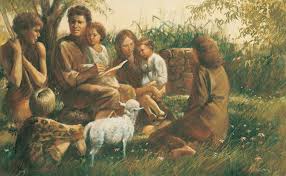
1. The Silence of Adam, by Dr. Larry Crabb, (Zondervan 1998)
4. Expository Studies in Genesis, by Ray Stedman
5. The Seed of the Woman, by Arthur Custance
6. The Theme of the Great Harlot in Scripture
7. The Consequence Engine,
8. The Scars or Sin, by Ray Stedman
9. A Woman's Worthby Elaine Stedman
Articles on Sexuality and Wholeness

The Snake in the Garden by James Montgomery Boice


Contributions
 Email Lambert: So far I have been able to answer all my email personally.
Lambert’s recent stuff (since 2018): About three hundred articles. Copyright free. Help thyself.
Newsletter Index
Original Home Page (1995)